



Game: Rune Factory: Guardians of Azuma
Genre: Action, RPG
System: Nintendo Switch and Switch 2 (also Steam)
Developer | Publisher: Marvelous (XSeed)
Age Rating: US Teen | EU 16+
Price: Switch (2): US $59.99 ($69.99) | UK £49.99 (£59.99) | EU € 59,99 (€ 69,99)
Release Date: June 5th, 2025
A review code was provided, and many thanks to Decibel PR.
Ever since the start of the series, every Rune Factory game has landed on my gaming consoles. As a spin-off series of Story of Seasons, Rune Factory added the very welcome diversion from farming, which is the base of Story of Seasons games. It adds a healthy dose of exploration and fighting enemies into the mix, and the games hooked me from the start.
The first four games were a big success on the DS family of systems, and though I wasn’t bowled over by Rune Factory 5, producer Yoshifumi Hashimoto still did a great job. Fast forward five years, and we have a new instalment of the series, called Rune Factory: Guardians of Azuma. With a new producer at the helm, Shiro Maekawa, Marvelous decided to take an entirely new direction with the series. Is this fan of the ‘old’ Rune Factory series ready for the change?
After the Celestial Collapse
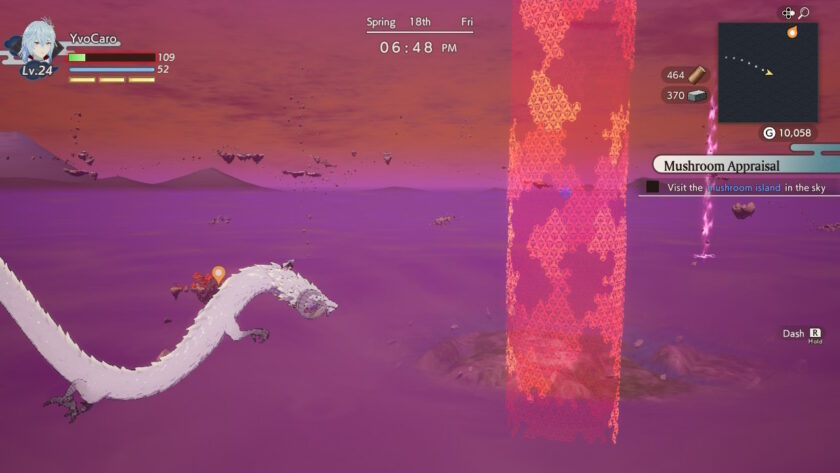
After a thrilling intro (I’ve always been fascinated by dragons!), my protagonist YvoCaro finds herself waking up with no memory and a fluffy, white and small companion, Woolby. Woolby looks like a Woolly, but he has curling horns and ads fun commentary to the adventure.
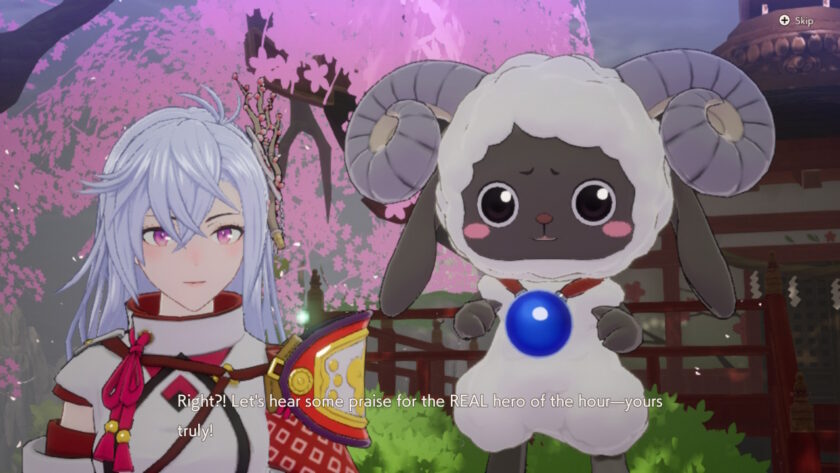
A great disaster, known as the Celestial Collapse, has left the land of Azuma broken and the gods of nature missing. And, of course, it’s up to YvoCaro (and, in extension, to me) to help restore balance and hope. A mysterious voice grants her the powers of an Earth Dancer, which sounds very important. Little does she know this means she’ll be very, very busy for some time to come. In a surprise move, she even gets the title of major handed to her for Spring village, and for the villages after that. A bit surprising, would you give control over to a total stranger? But of course, YvoCaro never shies away from a challenge!
Eastern Inspired with a Strong Protagonist
You can choose how you want to play Rune Factory: Guardians of Azuma. You can try for the difficult setting, the normal setting, or go for the story mode. This last one is easier, helping you focus on the storyline without frustration. Although I started on normal, I adjusted the setting to story mode after the first boss. I’m not very good at action-based fighting, and I’d only gotten through the first major fight by the skin of my teeth.
The tutorial is good. It fits in nicely while progressing the story, and it never felt annoying to be pulled out of the gameplay. New things are introduced constantly, and even after many hours of gameplay, new elements are still added.
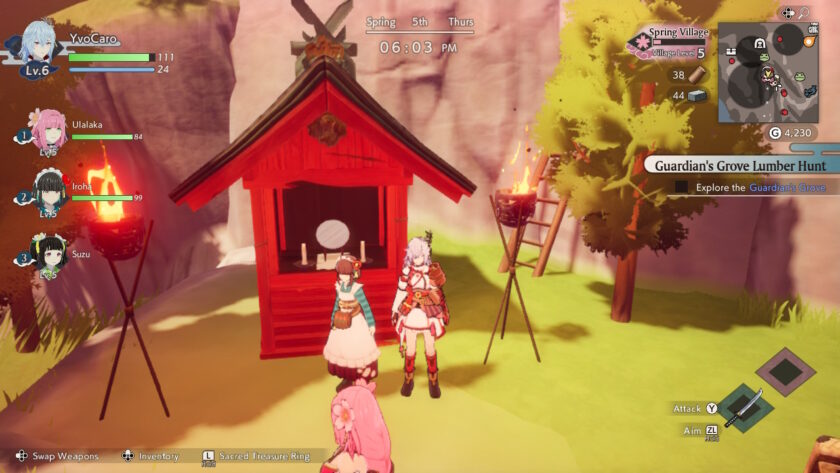
Quite a few elements stand out compared to the first five Rune Factory games. Azuma is an eastern-inspired region with architecture, fashion, and names influenced by Japanese culture. Most previous games are set in Western-style fantasy towns with medieval or rustic European influences.
You are an Earth Dancer, a special individual tasked with protecting Azuma’s elemental balance, restoring harmony with the help of Sacred Treasures. What I noticed is that you are a strong person; the other villagers depend on you as they feel you get things done. Not a character with amnesia who is helped to get back on their feet by the villagers, like in older Rune Factory games.
Managing the Village
In Rune Factory: Guardians of Azuma, you have to get busy with farming, rebuilding, and even reviving the gods themselves. In the earlier games, you had to do a lot yourself, until you could capture monsters and set them to work. This time, you only do some initial farming, but soon, people move back to the village. You can set them up to work in a range of jobs, such as working in the fields, taking care of mining, logging, or in shops. Each villager has special qualities, will deliver a certain amount of work, and will cost a certain amount of G to be fed.
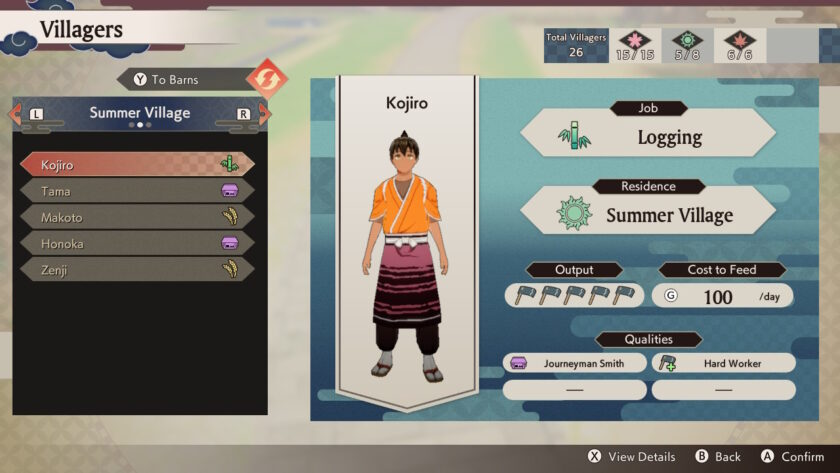
At first, you are happy with every potential worker coming through the gates, but eventually, you will have to manage the workforce to find the right balance. You also have to make sure they have enough tiles to sow seeds in. You don’t use a hoe to make those; instead, when you are in the building menu, Woolby can make them using red soil and rich soil, which in turn is made by weeds and withered grass.
You have to keep the villagers happy, and aside from offering ample housing, this can also be done by decorating the town, adding businesses and more. Crafting decorations is done by carpenter Takumi, but you have to provide the materials and the money. And of course, you need crafting recipes and cooking recipes too. You get recipes by awakening stone frogs and paying respect to shrines with the dance of Bonds.
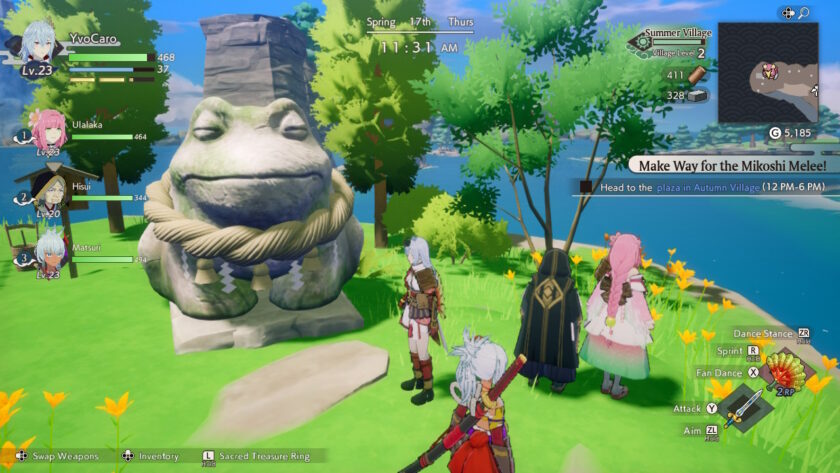
Instead of being a farming sim, this new Rune Factory game focuses more on managing the towns, the workers, and the satisfaction the inhabitants feel about being a part of your town. Even taking care of the animals you befriend is done by the villagers, and you can’t pet or brush them.
Some players might not like this change, but I really love it, tinkering with the revenues, happiness of villagers and levelling up the towns.
Romance and Friendship
True to the series, Guardians of Azuma also includes romance and friendship, with a full cast of voiced characters you can befriend or fall in love with. I like the way you can spend time with them and deepen the bond between you, not by running around the village together, but by choosing a topic you can discuss or by giving a gift. It costs a couple of minutes of your day, and you don’t actually witness what is discussed. But it’s an effective way to level up the friendship.
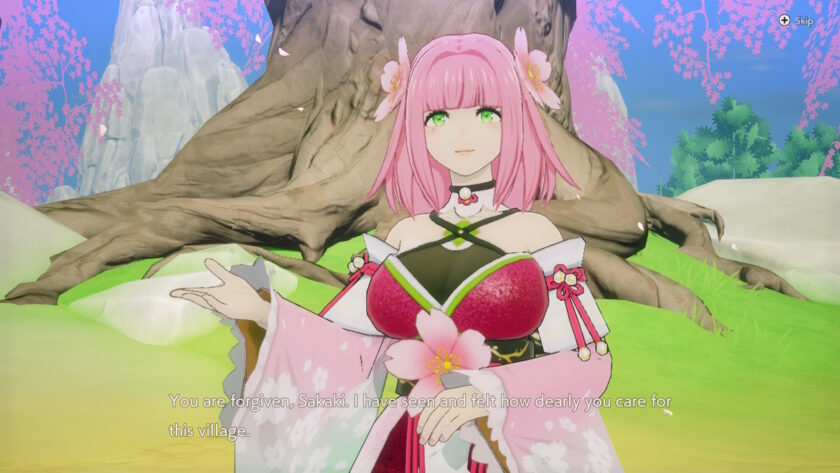
The characters are interesting, and I like the way you can put them in your team to explore outside in the countryside, thus bonding with them as well. In the fights with monsters, a good blend of attackers, defenders and healers is really very helpful.
Battles and Exploration
The fighting in Rune Factory: Guardians of Azuma is more intricate than in earlier games. Most monsters outside of the villages are quite ferocious, and there are many of them to vanquish before you can move in. Fortunately, the party that you can gather around you is a big help; it’s not like you still have to do most of it on your own. While they got your back, you can cure the land of the blight and revive trees.
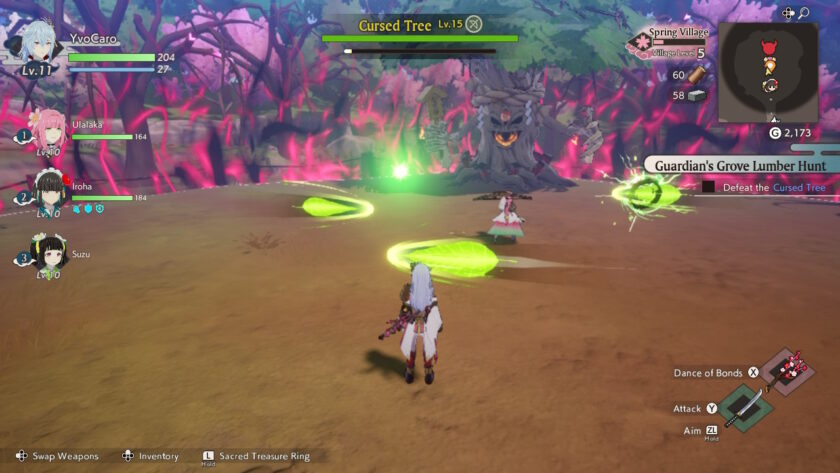
Combos are introduced, combinations using several buttons like the ZR button combined with X. Evasive moves that, when timed right, will stop time, briefly allowing you to deal more damage. As I mentioned, I’m never very good at mastering special evasive moves that stop time, or combos that deal extra damage. In story mode, the boss battles are doable, though, with the help of the Sacred Treasures, as they deal a lot of damage. Just be sure to stock up on plenty of meals that will replenish your HP or RP.
Exploration is a vital part of the game, and well fleshed out too. You’ll never be bored as there’s plenty to discover and fight. And once you unlock the ability to take to the skies, there’s even more to explore. Eventually, you can tame the wild monsters so you’ll have your own critters in a barn, being able to get their produce like eggs and milk. Cooking can be done at a campfire, or you can have certain villagers who will cook for you as long as you bring the materials.
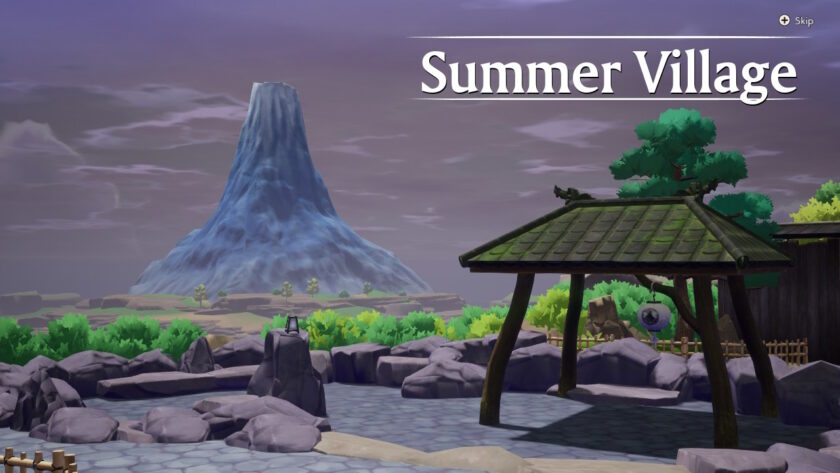
You can pick up quests from the quest board or ask specific villagers if they have quests for you. The quests are your bread and butter: you can earn money, but also logs and other materials. Most importantly, weeds and withered grass. They can be hard to come by, and you need them to make field tiles.
At the end of the day the statistics show you how you are doing managing the villages: how much did you ship out, how much do the workers cost and more.
Visuals, Sound and More
Rune Factory: Guardians of Azuma features a soundtrack that is clearly inspired by Eastern tunes. The soundtrack adjusts to what you are doing in the game. Gentle, melodic tunes play while you explore your farm or village, and when you’re out in the wilds or exploring dungeons, the music shifts to more upbeat and adventurous themes. It’s never intrusive but always there in the background, enhancing the gameplay experience.
Surprisingly, the game is playable in English! It’s been a long time since I’ve been able to play games like Rune Factory or Atelier in English spoken language, and I love it.
I like the game’s art style, once again completely different from earlier games that used anime-style visuals. Guardians of Azuma still shows us a colourful world, but the characters look more lifelike, complete with facial expressions. This makes for great vistas of the world of Azuma, too.
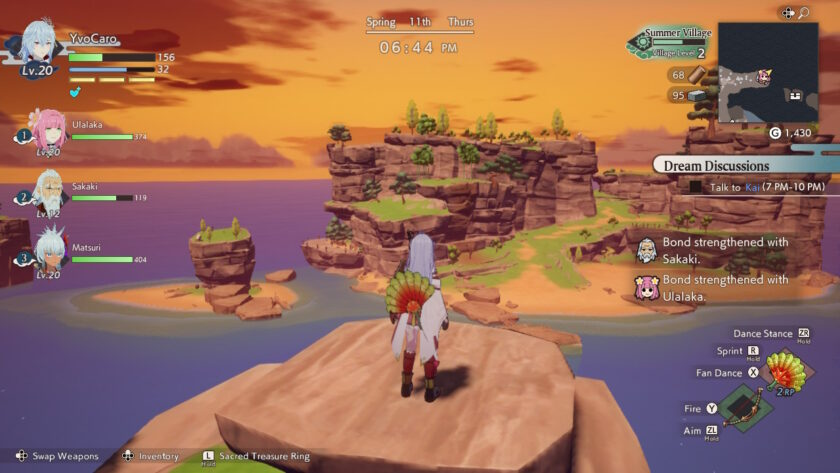
The game plays well on the Switch OLED in handheld mode, and the button controls are intuitive. But if you don’t like them as they are, you can also change the controller mapping.
Rune Factory: Guardians of Azuma takes inspiration from other games like the Atelier Ryza games. Boosting your skills, your weapons and the Sacred Treasures is done by unlocking them in a skill tree. Overall, it feels like a well rounded RPG.
Conclusion
Marvelous totally changed direction, and I can say I love it. They kept the essence of farming, exploring, and romance and put a new twist on all of it. Adding a management element into the mix by taking care of various villages and workers is brilliant; it takes away what can ultimately become a tedious chore. To me, the fighting is more difficult, but then I’m never a big fan of action fighting. But by adding story mode, it is very much doable.
There really is so much to tell about Rune Factory: Guardians of Azuma, I could fill many pages detailing all there is to do in the game. For now, though, I’ll add my verdict to this review.
Final Verdict: Two Thumbs Up
Do you like our content?
Support LadiesGamers as a member on Patreon!
 Or buy us a cup of coffee or tea on Ko-Fi!
